It’s hard to believe that it has been a little over six months since Tropical Storm Helene hit our mountains.
Since late January, the Buncombe County Special Collections team alongside a trusty crew of friends and volunteers have been working hard to preserve our memories of this disaster.
The Come Hell or High Water digital memory bank is growing by the day, thanks in no small part to our volunteers and community partners.

Since launching the project, more than 100 community members have submitted nearly 400 items to the digital memory bank. You can contribute your own images, videos, stories, creative responses and more to the project by visiting the contribution portal on the Come Hell or High Water website.
In addition to accepting these materials, we encourage you to share 3-minute stories, reflections and words of gratitude for community members or organizations (like this one!) via our hotline by calling 828-222-3609.
Besides crowdsourced community contributions, we’re also excited about collaborations with other museums and archives in our region. Archivists at the Special Collections at UNC Asheville’s Ramsey Library have contributed a collection of images of the Great Flood of 1916, and soon Come Hell or High Water will be home to materials collected by our colleagues at the Swannanoa Valley Museum and History Center.

The crew at SVM has been working hard collecting images, videos, oral histories and more. These materials will be available for access via the Come Hell or High Water project website ensuring that we capture the stories of the Black Mountain and Swannanoa communities. We’re so grateful that we can collaborate with these institutions to build a more comprehensive and inclusive archive!
We wouldn’t be able to do any of this work if it were not for the support of the Friends of Buncombe County Special Collections and community volunteers! More than a dozen folks have been offering their time and talents to making Come Hell or High Water a success for the past several months.
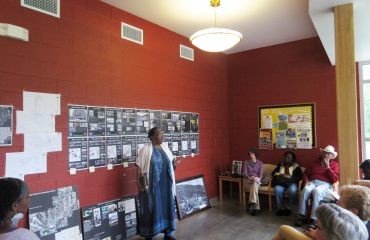
Last week, project volunteers gathered for a debriefing and social gathering. It was great to hear what all the teams of volunteers have been able to accomplish so far!
A few highlights:
- The Historical Research team has been hard at work scanning technical documents and reports from past flooding events, as well as information about planning and development in the River Arts District. Members of the crew have also been researching archival documents seeking personal experiences and additional images from past disasters like this diary that includes one young woman’s account of the Great Flood of 1916.
- Team Outreach has been flyering every available surface and sharing informational cards across town in addition to spreading the word via their personal networks. Members of the outreach crew have started planning a series of storytelling events and brainstorming programming to engage young people in the project. Look out for more info from the outreach team soon!
- The Oral History team has completed two oral history training sessions led by team co-leads Susan Kraft and Ann McCutchan.These training have included discussions of technology as well as best practices for conducting trauma-informed oral history interviews, ensuring consent, safety, respect, and empathy for the narrators who have generously agreed to share their stories. Volunteers have begun scheduling interviews to record the accounts of our friends, neighbors, and colleagues who were impacted by the disaster and who contributed to essential relief and recovery efforts in its aftermath.
- The Tech/Admin team has been busy moderating and publishing community contributions, ensuring all of the metadata is standardized so that viewers of the site can navigate and search the collections with ease. Additionally, we have recently met to learn the process for bulk uploads of multiple-item contributions. One volunteer has been updating the standards and procedures for these processes in a shared how-to guide complete with screenshots so that when new volunteers come on board, we can quickly get them up to speed. Team tech has also cross-collaborated with the outreach team, encouraging contributors to share their contributions on social media. Creating controlled vocabularies for subject terms and tags is currently underway.

Finally, facilitating creative responses has also been an important facet of the Come Hell or High Water project. The experimental art collective Swannatopia has taken over a section of our reading room to present the exhibition “And the green grass grows all around and around and the green grass grows all around.” Many of the objects on display were created in response to the prompt “How Do We Mark The Flood?” for an event held in November 2024, as well as other projects in the months since. Works on view are paired with library research resources highlighting the histories of agriculture and arboriculture in our region. Swannatopia’s exhibition will be on view through Tuesday, June 10, 2025. Learn more and join us for events in conjunction with the exhibition.
You can find more events centered around recovering and building resilience as a community throughout Buncombe County Public Library’s twelve branches, including sharing and support sessions. For disaster recovery resources, please visit Buncombe County’s Helene Recovery portal and the Asheville Recovers Engagement Hub.
If you’d like to get involved with documenting our community’s experience as a Come Hell or High Water as a project volunteer, or to find out more details about contributing to the project, please send an email to the Friends of Buncombe County Special Collections at friendsbcsc@gmail.com.