

Have you noticed some new faces at Pack Memorial Library?
We’ve got a couple of new furry residents who will be sharing insider info about library life on social media!

Remy (she/he/they) and Ratticus (he/him) are the Pack Rats, representing Pack Library’s Youth Services and Adult Services departments, respectively. (We’ve got to invite both of them both for a tour of Special Collections soon.)
So far, we’ve seen them in one post, in which we learned that Ratticus’s favorite book is Harper Lee’s To Kill a Mockingbird, and Remy’s favorite is Ratatouille. (Okay, it’s not a book, but you can check it out from the library, so we’ll let it slide.)
You can follow the adventures (and misadventures) of Remy and Ratticus on Pack Memorial Library’s Facebook page or Instagram.

But the Pack Rats are far from the first four-legged friends to find a home in Pack Memorial Library. We got inspired to look into the history of animal mascots in our library system, and found that Remy and Ratticus are building on a time-honored tradition of nocturnal nibblers nesting in our nooks of books.
Read on to learn about Cadmus the Possum as well as some more recent visitors to BCPL branch libraries.
Cadmus the Possum
In 1952, when our main library was still located on Pack Square, the Asheville Citizen reported on the appearance of what they called a “new variety of ‘culture vulture’ in the stacks.[1]
And what an appearance! “Like many intellectuals,” the newspaper said, the mystery visitor “shows not particular concern for neatness: uncombed hair sets off a long bony nose and his beady eyes, and accents the several long whiskers that protrude near his nostrils.” According to head librarian Margaret Ligon, he was “the hairiest, dirtiest, mangiest, most ruffled and hideous creature I ever saw.” (Dearest reader, please pardon Miss Ligon. We don’t talk about our patrons that way these days.)

The “culture vulture” (Dictionary.com: “an individual with a consuming or excessive interest in the arts”) was indeed not a vulture at all, but an especially literate, artistically inclined native opossum (Didelphis virginiana). Ungenerously, the paper made a point of noting that its appearance was NOT similar to that of the amiable character of Pogo Possum, whom newspaper readers would have known from the eponymous comic strip set in the Okefenokee Swamp.

Nevertheless, appearances can be deceiving: the possum that made its way into Pack Memorial Library in 1952 was a creature of refined tastes. At the time, the library was placing a particular emphasis on bringing cultural experiences to locals who might otherwise not have the opportunity to experience them: foreign film screenings, art exhibitions, music and theater performances.

Flyer for October 1952 events held in Pack Memorial Library’s Exhibition Room, from scrapbook in the Asheville-Buncombe Library System Collection, MS080.004.
The possum made his first appearance in October, when the library hosted a screening of the 1930 German film The Blue Angel. He enjoyed spending time in the exhibition room, where an exhibition of paintings by 20th century American artists was on view, on loan from the Metropolitan Museum of Art in New York City. Clearly curious about the world, he carried a copy of diplomat Willard L. Beaulac’s 1951 memoir Career Ambassador up from the library’s basement to a counter. For about a week, he evaded capture.


It may have been this reading choice that led to Pack’s possum being given the name “Cadmus” (or he may have been named for the Greek hero who introduced the alphabet to the Greeks). Minnie Frank Hays Moseley (Mrs. Robert Moseley) noted in a newspaper editorial:
You may be interested in knowing that Cadmus, the literary ‘possum, is not the first one from North Carolina to have diplomatic aspirations. In 1825, four of them, two males and two females, went to Paris. Their passage was booked on a ship named Cadmus, but the Marquis of Lafayette and his son, George Washington Lafayette, who had landed in New York harbor in January from the same ship. Arrangements were made by the Marquis and his son for the ‘opossums,’ as they called them, to transfer in Le Havre to the roof of the Diligence, or stage coach, for Paris, where they were to take up residence in the famous botanical gardens, or Jardines Plantes, as guests of certain noted French scientists.
Marsupial records being somewhat inadequate, we can only surmise that Cadmus of Asheville is a collateral descendant, many times removed, of these four early American diplomats.[2]
Alas, Pack Memorial Library staff apparently had little interest in diplomacy. After a week-long search, they tossed poor Cadmus out.[3]

And that’s where it might have ended had Cadmus not by this point become a symbol representing all of Pack’s library patrons. When Gallup surveys reported lower reading rates across the nation, the editors of the Asheville Citizen refused to believe it could be the case here. After all, Asheville was “so crowded with book lovers” that even the wildlife was devouring nonfiction.[4]
Then, in a shocking turn of events, the editors of the Greensboro newspaper of record cast aspersions on this claim of high literacy.[5]
Naturally, the Asheville Citizen defended the reading habits of Asheville citizens—with receipts.[6]

Facing these startling statistics, Greensboro, of course, was forced to admit defeat. They graciously extended an invitation to Cadmus to visit the Greensboro Public Library, in the hope that having a celebrity browsing their stacks would bring some clearly much-needed publicity.[7]
It is unknown whether he took them up on the offer.


…So, not to start beef or anything, but how does this compare to today?
The state’s 2022-2023 statistics for North Carolina Public Libraries show that despite an even wider gap in population, our readers are still eking ahead. Greensboro’s central library and seven branch libraries had a “total collection use” (print books and electronic resources) of 1,831,839, while Pack Memorial Library and the 11 branch libraries of Buncombe County Public Libraries stood at 1,923,082.
| 2022-23 library service population area[8] | 2022-23 total collection use[9] | |
| Buncombe County Public Library | 273,403 | 1,923,082 |
| Greensboro Public Library | 434,234 | 1,831,839 |
We still got it, Cadmus!

Bookish Beasts and Where to Find Them
Over the years, as our library system has changed locations, added branches, and expanded services, creatures of all species have continued to seek the resources of the library. We’ve hosted countless programs bringing furred, feathered, scaly, and slimy friends for patrons to learn about (shout out to our friends at ecoExplore and the WNC Nature Center!) but we’ve also had our share of uninvited visitors. We asked our colleagues to share some of their stories.
Leicester Library & Swannanoa Library
Who says ‘lizard brain’ is a bad thing? Library Maintenance Technician Steven recalls that a pair of king snakes used to sun themselves on a rock outside the Leicester Library, like our very own reptilian versions of NYPL’s famous guardians Patience and Fortitude.
Recently, both the Leicester Library and the Swannanoa Library have also hosted skinks, albeit with rather different personalities and reading preferences. According to Librarian Jen W., the fellow who visited the Leicester branch in 2021 enjoyed his time in the children’s section (maybe especially because the library staff provided him with lettuce and a bowl of water). At the Swannanoa Library, in May 2023, a common five-lined skink (Plestiodon fasciatus) was found “hanging out in our large print room amongst the potted plants, and was very relieved to be returned outdoors,” reports Library Assistant Sabrina-Delphine.


Fairview Library
Meanwhile, the Fairview Library attracts flamboyant fowl: Jill S. was the only regular staff member working there earlier this year “when a peacock decided to wait outside our entrance for someone to feed him. I brought him a bowl of water from which he drank and he definitely wanted to get in the library each time I opened the door. Our close neighbor brought out peanuts and dried cherries that he tossed to him.” He was identified as Peanut, the sole survivor of a 2023 brood from peacock parents Peter and Penelope, who had appeared at a house in the neighborhood several years ago and stuck around for a while.

Oakley/South Asheville Library
Over at the Oakley/South Asheville Library, Librarian Grace recalls in vivid detail the time that some feathered foes took residence ON (though not technically IN) the branch:
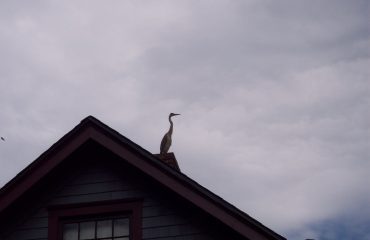
“For several months in late 2023 and early 2024 we had a murder of crows and a committee of turkey vultures battling for who would ultimately take residence on the roof. We could tell mostly by the noise: the crows sounded almost like human footsteps crossing tap-tap-tap quickly across, while the turkey vultures produced a prolonged thumping/flailing/dragging sound that made many a patron come to the desk and ask with great concern, ‘Is someone being attacked up there?’ It was also quite ominous to arrive in the morning or leave at the end of the day and see a huge flock of birds all watching us with their shrewd, beady eyes. We made sure to order some juvenile nonfiction books so that anyone interested in the feuding birds could learn more. It was quite a battle for dominance, with each group gaining the upper hand at one point or the other, but in the end both crows and vultures eventually left. We will occasionally hear the tap-tap-tap of a single crow, but the murder seems to have moved on.”

North Asheville Library
Library penthouses are hot real estate for our local wildlife. At the North Asheville Library, sounds of scratching in the ceiling were the first hints that a new tenant had arrived. A mouse, thought library staff at first—then, as the sounds grew louder—a rat? Perhaps a squirrel? Even larger, they soon realized, as Librarian Sara K. heard heavy footsteps above her desk and watched the drop ceiling tiles sag with weight. Luckily, no animals came crashing down into the library: upon investigation, a responder from General Services came face to face with a raccoon. A family of 3 raccoons, it turned out, had made a comfortable home above their local library. After “a bunch of running around and yelling,” Animal Control drew them out with a tasty treat of marshmallows.
“We’ve theorized that marshmallows work because so many campers have them with them, and raccoons are notorious for campsite raids,” Branch Manager Matt explained. The raccoons were humanely relocated far away from the branch library, but not before staff snapped a picture of one of them, “looking sad to have lost his cushy library home.”

West Asheville Library
Libraries connect patrons to resources in times of need, and the West Asheville Library is no exception, having provided rescue services to several species.
Librarian Kim E. recalls that “twelve years ago or so, an eagle-eyed patron saw a parrot, a beautiful sun conure, clinging to a window screen in front of the window near the magazines at West.” It stepped tamely onto Kim’s arm, and spent the whole day with staff in the library. They were able to connect with a patron who was also a parrot-parent. The patron looked for an owner to no avail, and then brought the vibrant bird to a parrot rescue organization.
About a year ago, “little mewing noises” alerted West Asheville Library staff to the presence of an adorable half-grown black cat hiding under a table—unfortunately, in poor physical shape. Staff caught the kitty in a book basket, then solicited the help of Animal Control to bring her to the animal shelter for medical attention.
Pack Memorial Library
Across all the branches, Library Maintenance Technician Steven has been the go-to for many critter concerns over the years—to the benefit of the creatures involved, since he is an animal lover who keeps the deer, turkey, and squirrels at his own home well-fed. “Animals are just misunderstood,” he reflects, remembering the many so-called pests he has helped out, from a squirrel who broke into the library circa 2007, to various bats, rats, and snakes.
Here at Pack Memorial Library, he has relocated a squirrel who broke into the library (circa 2007), and helped with several batty matters. Before HVAC upgrades, he recalls, opening the library windows to provide airflow was a regular practice. Occasionally, those windows were accidentally left open at night, and a little brown bat came in to explore (before being caught in a small cloth bag and relocated).
Bats and more have also lived outside the library. In fact, former Special Collections Manager Zoe donated a bat house that is still in the courtyard. Steven remembers that once a box turtle burrowed into the courtyard and made a nest, living there for six months before he managed to find it and return it to its natural habitat. A falcon used the courtyard as its regular hunting ground “back in the day,” swooping down and eating up smaller birds. And then there was the time that a broken city sewer pipe led to a number of rats taking up courtyard residence (probably not as cute as the new Pack Rats, but who’s to say?)
Librarian Tammy S. also remembers how a horse patiently waited in the garden outside the children’s department whenever its rider used the library, to the delight of young patrons for several months in 2009.

Most recently, you might have seen the black bear who made its way to the parking deck behind our building. Ultimately, this fellow decided not to enter the library. We can only assume he found his desired reading material on Libby instead.

Have you had any wild adventures at your local library? Tell us about it in the comments!
Post by Carissa Pfeiffer, Librarian, Buncombe County Special Collections, with special thanks to my animal-loving BCPL colleagues & to every furry, feathered, slimy, or scaled creature mentioned herein.
[1] “New Variety of ‘Culture Vulture’ Makes Appearance at Pack Library,” Asheville Citizen, October 16, 1952. https://www.newspapers.com/article/asheville-citizen-times-possum-in-the-li/148841957/
[2] “Add ‘Possum: Cadmus and Lafayette,” Asheville Citizen, November 24, 1952. https://www.newspapers.com/article/asheville-citizen-times-possum-in-the-li/148842038/
[3] “Mystery Visitor is Nabbed at Pack Library,” Asheville Citizen, October 22, 1952. https://www.newspapers.com/article/asheville-citizen-times-possum-is-myster/148842166/
[4] “’Possum in the LIbrary,” Asheville Citizen, October 23, 1952. https://www.newspapers.com/article/asheville-citizen-times-19521023actp/138173816/
[5] “’Possums and Readers,” The Greensboro News and Record, October 26, 1952. https://www.newspapers.com/article/news-and-record-greensboro-questions-ash/148883743/
[6] “Add: ‘Possum in the Library,” Asheville Citizen, October 28, 1952. https://www.newspapers.com/article/asheville-citizen-times-possum-in-the-li/148841800/
[7] “Cadmus, The Literary Possum” Greensboro News and Record, November 7, 1952. https://www.newspapers.com/article/news-and-record-cadmus-the-literary-poss/148886365/
[8] State Library of North Carolina, The Statistical Report of North Carolina Public Libraries, 2022-2023 Draft Data Tables (Excel), Table 1: Library Profile. Accessed June 7, 2024. https://statelibrary.ncdcr.gov/services-libraries/resources-library-staff/data-and-evaluation/north-carolina-public-library-statistics
[9] State Library of North Carolina, The Statistical Report of North Carolina Public Libraries, 2022-2023 Draft Data Tables (Excel), Table 9: Circulation: Type of Material. Accessed June 7, 2024. https://statelibrary.ncdcr.gov/services-libraries/resources-library-staff/data-and-evaluation/north-carolina-public-library-statistics

Well done!