

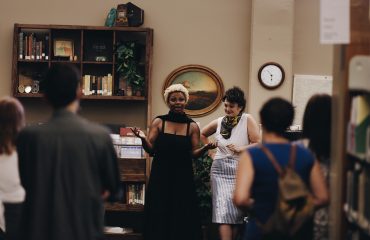
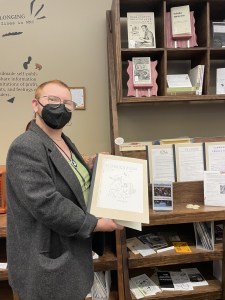
BCSC’s 2024 artist resident, photographer Eric William Carroll, recently opened a new exhibition in our reading room highlighting the rich range of scrapbooks in our public library collections. On April 23, he presented a research talk as part of the opening reception of the exhibition. He’s also been hosting “scrapbook office hours” at library branches across Buncombe County, with three more to come (Saturday, May 11, 2 – 4pm at the Fairview Library; Thursday, May 16, 1 – 3pm at the West Asheville Library; and Tuesday, May 21, 5:30 – 7:30pm at the Enka-Candler Library).
Today on the blog, Eric will showcase some of his favorite examples from the scrapbooks he encountered, share his findings about the history of scrapbooking in Asheville and Buncombe County, and investigate what that means today!

Hello all! First off I’d like to thank all the folks at Buncombe County Special Collections for being so helpful and excited about the scrapbooks in their collection. It’s been a true pleasure to time travel through Asheville’s history via the vernacular scraps saved and arranged by its citizens. Since I’m an artist that works with photography and obsolescence, the scrapbook was a perfect match for my interests. And while it’s impossible to condense all my findings in a single post, I’ve rounded up the main points to take away from my residency.
First, what was I looking for? For me, the “ideal” scrapbook has the following qualities:
- Draws from a variety of sources
- Reveals the personality of its author(s)
- Lays out material in a dynamic/engaging manner
- Is far from perfect
- Can be appreciated by a total stranger
For the archivists in charge of these collections, I’ll add to those that ideally, it also includes important metadata (who/what/where), and it is created with archival materials so that it lasts long enough for those strangers and researchers to encounter it.
[Check out tips from the Iowa Conservation and Preservation Consortium, the Library of Congress, and the Northeast Document Conservation Center about preservation considerations when creating scrapbooks!]


The Thomas A. Weston Scrapbook was the one that brought me into this residency, specifically the page spread at left featuring leaves and botanical specimens. Created in 1878, it was one of the oldest scrapbooks I looked at–and it mirrored my personal experience in unexpected ways. Like me, Thomas A. Weston was a transplant to Asheville, drawn to it because he loved the climate, which he compares to St. Paul, MN. In the late nineteenth century, more Americans in general were travelling, and scrapbooking activity surged as a result. Weston’s scrapbook presages the boom in tourism that Asheville specifically would see with the introduction of rail service via the Western North Carolina Railroad in 1880.
It’s also a great example of a scrapbook because of its range: Weston created lots of written entries coupled with newspaper clippings and other printed ephemera. The reason scrapbooks became popular is because the advent of lithographic printing (and photography) resulted in an explosion of inexpensive printed matter everywhere (think about the way we think of digital screens today).

Another excellent example of a scrapbook was this one made by Ruth E.K. McDowell in the 1920s when she was a student at Asheville High School. It contains a wide range of materials, interesting layouts & juxtapositions, some useful metadata and conveys the lively, playful personality of its author.
Drawings appear throughout the scrapbook of “Spark Plug,” the beloved horse character from cartoonist Billy DeBeck’s comic strip Barney Google and Snuffy Smith (Spark Plug was “such a star during the 1920s,” notes Don Markstein, “that children who enjoyed the comics were liable to get ‘Sparky’ for a nickname—for example, Charles M. ‘Sparky’ Schulz, who grew up to create Peanuts.”)


Ruth and Bess McDowell both created scrapbooks that show what life was like for young women in Asheville in their time. The materials are eclectic, ranging from greeting cards to printed napkins, recalling the visual language of collage and assemblage. They are also quite physically tactile: reading is a physical act. It can take quite a while to get through even a single page, opening envelopes, unfolding letters, and flipping through multiple layers pasted onto one page.
Their work also reveals a shift in practice. “By World War I,” writes Jessica Helfand, “the pastime that had for generations been housed in the family parlor became a more individual, and arguably more private, pursuit.” The love letters (and letters of unrequited love!), personal notes, and report cards in the McDowell scrapbooks, like the contents of other scrapbooks of the time, “reflect altogether new and different sorts of social, cultural, and emotional preoccupations. The scrapbook came to be seen as a kind of time capsule, an archive of printed miscellany, personal anecdotes, and material remnants that filled a private need, yet at the same time reflected a tacit awareness of certain public values.” Sentiment, social life, and mass media awareness prevail.


And then there are the clubs! Many scrapbooks in the collection are dedicated to collective pursuits, including service organizations like the Twentieth Century Club, Pilot Club, and school PTAs. Some of these reveal the creator’s personality, while some are more formal pursuits with less commentary and more emphasis on visual symmetry and minimalism.


This massive scrapbook, titled “Brick by Brick: A Community Rich in Spirit Treasures Its Memories” was created by Michelle Heller and Barbara Laibson to celebrate the history of the Jewish Community Center during construction of their new building in 1993-1994. Here, the scrapbook pages double as poster design. Hundreds of photos taking back to 1949 were gathered on 23 x 35 inch pages which were hung on a wall before being gathered into a scrapbook format.


One of the few scrapbooks that document Black life in Asheville is this one by Mae Bell Burton, created in 2012. Burton is also interestingly juxtaposing newspaper articles about public events relevant to Asheville’s Black community with personal family photographs.
While scrapbooking is a fairly democratic medium–all you really need are scraps, after all, and no formal training is required nor expected–it still takes time, space, and materials to create a scrapbook, hold on to it over time, and ultimately pass it on to the next generation. Unfortunately, many stories aren’t told because people may lack those resources. If you don’t see people like yourself represented in collections, it’s a good sign that your story is worth telling & preserving.
The connection between material resources and scrapbooking–or really, between capitalism and scrapbooking–has a long history. Samuel Clemens held a patent for scrapbooks which he branded under his pen name “Mark Twain,” and in fact made more money from his scrapbook profits in 1877 than he did from his writing. His “self-pasting” scrapbooks were sold pre-affixed with moisture-activated adhesive. (An archivist’s nightmare but a consumer’s dream, apparently!)

The commercialization of scrapbooking rose to new heights in the late twentieth century. The level of visual interest in scrapbooks drops off in the 1980s-2000s for many possible reasons: people once engaged in the practice are no longer around, other ways of saving & sharing scraps emerge, and perhaps they just aren’t represented in the collection yet. But the shift to the familiar 12×12 pages, stickers, and pre-designed templates really began when scrapbooking started “trending” as a hobby with a specific shopping list attached.


The scrapbooking industry thrived on selling you all the accessories you needed to scrapbook, with a specific focus on built-in-nostalgia. The marketed scrapbook of the late 1990s and early 2000s led to both a visual monoculture as well as a performance of personality & Western family ideals.

The scrapbooking industry doubled in size between 2001 and 2004 to $2.5 billion with over 1,600 companies creating scrapbooking products by 2003. According to Google Trends, the search terms related to scrapbook and scrapbooking have seen a 70 percent decline since its peak in 2005–2006.
Creative Memories, a home-based retailer of scrapbooking supplies founded in 1987, saw $425 million in retail sales in 2004. However, Creative Memories’ parent company filed Chapter 11 in 2013.


The emergence of social media aligns nicely with the decline of scrapbooks. In comparison to the heyday of scrapbooking, here are some changes in how many of us are “scrapping” in a digital age
- Saving “everything” in the cloud
- Time between event & sharing is minimal
- Almost always public-facing
- Rarely looked back on
- Editing & narrative performed by the algorithm
- Corporate-owned
- Metadata sold & used by advertisers
What happens to our history if we are storing all our content with corporations? I’m not necessarily lamenting the loss of print, but concerned that our everyday visual experience on screens is not being properly archived & edited.

Hence, the screenshot scrapbook! This is an exercise, using the digital “scraps” of today’s life, that:
- Re-focuses on everyday content
- Selection & editing done by humans
- Only required accessory is a smartphone
- Preserves our screen-based lives in context
- Printed as a physical book
- Fits in your pocket


Want to contribute to the project (and the exhibition)?
Create twenty-four screenshots from your phone or tablet. Avoid cropping if possible. Feel free to redact any personal information. Collect these screenshots in a folder and be sure the filename indicates the order in which the screenshots should be presented. Then share these files with me–and I’ll print your book for you.

Think about a narrative or structure for your scrapbook. Is there a theme or recurring ideas in your screenshots? A fun place to start is using the “Day in the life of” template–make screenshots periodically throughout the day instead of collecting a bunch at once.
In general, the more unique your screenshots are, the more valuable they will be to cultural historians. Try to go outside your comfort zone and ask yourself what you’d like to see in scrapbooks made by others.
This is a weird exercise–enjoy it! We so rarely look back at our screen-based lives. This is a chance to reflect on how enmeshed these devices and their aesthetics are part of our culture.

Further Reading
Ellen Gruver Garvey, “Mark Twain and the Phenomenon of Scrapbooks,” Connecticut Explored Inc. Winter 2020-2021, https://www.ctexplored.org/mark-twain-and-the-phenomenon-of-scrapbooks/
Jessica Helfand, Scrapbooks: An American History (New Haven: Yale University Press, 2008). [Available to borrow from BCPL.]

Post by Eric William Carroll, 2024 Carolina Record Shop Creative Resident, with Carissa Pfeiffer, Librarian, Buncombe County Special Collections.

[…] anniversary of Building Bridges of Asheville, another will showcase LGBTQ+ Pride in Asheville, and Eric William Carroll’s exhibition about scrapbooks in our collections continues to be on view in the reading room. Plus, join us for free public […]