

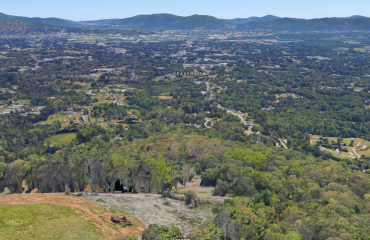
Asheville’s real estate boom in the 1920’s fostered the growth of many neighborhoods: Lakeview Park, Malvern Hills, Horney Heights, and Kenilworth, just to name a few. Biltmore Avenue borders Kenilworth on the east and across the avenue, on a knoll overlooking Biltmore Village, is the pocket neighborhood of St. Dunstan’s Circle.
A Mr. Roebling first purchased the area comprising St. Dunstan’s Circle. It had a view of Biltmore Village and, at that time, probably had a view of the “new” Kenilworth Inn. And yes, Mr. Roebling was the son of the Roebling of the same nam who built the marvel of The Brooklyn Bridge.
Then, as now, names with vaguely British roots were in vogue for the streets of newly created neighborhoods. St. Dunstan (908-988) was a popular English cleric: Abbot of Glastonbury, Bishop of Worcester, Bishop of London, and Archbishop of Canterbury. He was also a goldsmith! After he was canonized this popular ditty was well known in the British Isles.
St. Dunstan, as the story goes,
Once pull’d the devil by the nose,
With red-hot tongs, which made him roar,
That he was heard three miles or more.
See what I mean about rabbit holes?
Newspapers.com is my go-to for research. I found several real estate advertisements for the proposed St. Dunstan’s development. The earliest advertisement is from July of 1920. (Don’t forget: newspapers.com is an invaluable research tool you can use when you visit the NC Room at Pack Library!)
By 1925 an advertisement for a room to rent in one recently built home appeared in the Asheville Citizen-Times.

Another advertisement appeared in my Citizen-Times search in the same year for a poultry farm on St. Dunstan’s Circle. Now that’s what I call a newsworthy rabbit hole!

In a quick check of the biographical files in the NC Room I found a biographical sketch written by Elsie Allport Bennett that was donated to the NC Collection in 1992.
James Hobart Allport, born in Pennsylvania, moved to Asheville with his mother in the late 1800’s. He operated a construction company, which quarried stones in Chunn’s Cove and transported them over the mountain to the site where Grove Park Inn was being built.

Mr. Allport also built a storage warehouse on Valley Street. The blonde, brick building still stands behind the city and county buildings.

According to his daughter’s biographical sketch, he laid out all the streets, curbs, and pavement in Lakeview Park. And built the dam which created Beaver Lake. There was no mention of the poultry farm in her biographical sketch! But I found an article that described the poultry farm, as well as an article that listed the prizes won by the farm’s poultry.

As a reminder, this post is a part of our 52 Weeks, 52 Communities Series. In this series, we are covering a different Buncombe County community each week. Do you have materials related to St. Dunstan’s Circle, Odessa or some other Buncombe County community you’d like to let us know about? Do you, your parents or grandparents have a good story to tell? We want to hear from you! The North Carolina Room is Buncombe County’s Public Archive, we want to help preserve and make accessible the history and culture of Asheville and Buncombe County for all its residents.
This post was authored by Terry Taylor, Board Member of the Friends of The North Carolina Room at Pack Memorial Library.

Thanks for this. I knew the Roebling name sounded familiar for another reason. He was first cousin to Mr Washington Augustus Roebling II, who died on the Titanic. Washington was named for his uncle, the father of the developer of St. Dunstan’s neighborhood.