

“One of the most popular bands in the sixties in Asheville was Bee Bumble and the Stingers. They were a garage band that the whole neighborhood in Lakeview Park near Robinhood, used to hear practice in their garage. A lot of Asheville’s finest were raised in North Asheville.” [From an oral interview with Nancy Alenier which was the basis of last week’s post on North Asheville’s Music Scene and the Brass Tap.]

“Asheville Citizen-Times” October 29, 1967
The band’s members were Bill Privette, lead guitar and trumpet; Bill Coffey, rhythm guitar and lead singer; Bob Merrill, bass guitar; Mike Davis, organ, and Steven Stewart on the drums; Tony Scott, sax, and not shown in the above photo, Bruce Caldwell, also on sax. Mr. Ray Cain was their manager. They started out as a Dixieland Band, then became a folk group and finally turned to rock and roll.
About five years ago, Mountain Express journalists came to the North Carolina Room for us to help them find information about local garage bands. We had nothing, but helped them in their research. Here’s the link to the third in their remarkable series which covers Bee Bumble and the Stingers. “Asheville’s 60’s Garage Rock Scene.”
So, other than the Brass Tap and all of its pre and post incarnations at 633 Merrimon Avenue–that were so essential to Asheville’s live music scene–
there was also the Cosmic Ballroom!

“Asheville Citizen-Times” March 14, 1976
which was “Located Under Roses on Merrimon Avenue.”
That would be the current location of ‘under Stein Mart’ at 848 Merrimon Avenue.
Barbara Blake, in a 1976 newspaper article, “Young Seek Own Nightclubs” wrote that prior to 1976 Asheville’s music scene had “a history of conservative entertainment aimed at the mature adult crowd.” But now, “there’s a fresh new sound in Asheville.” (Asheville Citizen-Times March 14, 1976.)
The Cosmic Ballroom, operated by Jerry Mitchell, was known for it’s “lighted dance floor, reflecting every hue in the rainbow while gaily-clothed dancers move wild and free in front of vast mirrors.”


And there was Doc’s Rock Shop, too.
Dr. Robert R. White, who held a Ph.D. in electrical engineering, opened Doc’s Rock Shop in 1974 in the previous Chez Paul nightclub–and it opened in time for New Year’s Eve with the newspaper reporting the bar was “jammed and swinging.” Doc’s offered a giant 27-square-foot television screen in one room, said to be “Asheville’s first big screen and the first this side of Knoxville.” Dr. White also installed a sound system “powerful enough to fill four football stadiums . . . with the maximum distortion of .003.” He doubled the Chez Paul dance floor and added a color organ at ceiling height around the entire room. Color flashed through glass paneling along the top of the walls, changing to the frequency of the music. (Asheville Citizen-Times Dec. 28, 1974.)
Nancy Alenier remembers Doc’s as a disco and recalls the disco ball. “It was a real hang out. It was a rock place, and rock in North Asheville was inconceivable. I call it gritty. I call it soul.”
Both discotheques had a standard admission of $1 per person every night and offered a place where young people could laugh, and dance and have a beer . . . and call the place their own. As Barbara Blake put it so well, “Something about the mystical lights, the pulsating music and the smoke-filled dimness generates a a magnetic feeling of unison among the people who keep coming back night after night, week after week.”
One thing I didn’t understand though was a house rule common to both the clubs was that “no marijuana is smoked inside.”

Circa 1950s-60s postcard of Chez Paul Restaurant which was operated by Paul and Gabrielle Houdeille from 1934 to 1952 when they sold it to the McKenzies, owners of the Asheville Fish Company, who continued the restaurant.
Speaking of the earlier conservative entertainment, while mention is made of Chez Paul, in another North Asheville oral interview with Tricia Pinkston Coxey, who grew up at 136 Windsor Road, she recalls Sunday night at Chez Paul’s as family only. Saturday night was for grown ups. “The moms and dads would get dressed up and they’d have live music. And I want to say that that’s about the only place around that you could get live music. And you had to have reservations.”
Post by Zoe Rhine, Librarian.
Do you have any photographs of these important locations from Asheville’s music scene, or know of anyone who might? We are also looking for photographs of Merrimon Avenue during this time period. If you have any photographs of North Asheville that you think deserve to be documented, please give us the opportunity to scan them and add them to our Special Collection database. Please contact the North Carolina Room at 828-250-4740.
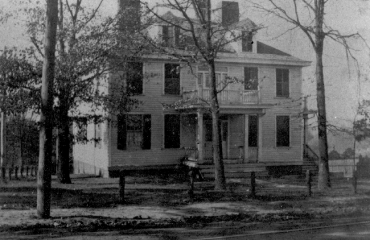

Dennis young built and opened up the cosmic Ballroom and then sold it to Jerry Mitchell!
Monday Nights at the Brass Tap
There were nights at the Brass Tap that you don’t forget—not because anything was planned, but because nothing was.
It sat in a small strip mall on Merrimon Avenue in North Asheville. At one end was a convenience store. In the middle was a vacuum cleaner shop. And tucked right at the far end, almost like it had been pushed there by everything around it, was the Brass Tap.
A small bar with open doors in the warmer months, letting the sound pour straight out into the parking lot.
Inside, there was barely room for it all.
Maybe thirty seats if you counted carefully. A handful of stools at the bar. A stage so small the drum kit looked like it had been squeezed into place after the rest of the room was already full. Musicians stood close enough that nobody could pretend they weren’t listening to each other.
Along one side of the room, there were even a couple of early video game cabinets at the bar—simple glowing machines that hummed quietly in the background when things slowed down. Another layer of noise in a place that was already full of sound.
In the early to mid 1980s, Monday nights became something steady there: the jam.
People came in early, because if you showed up late, you might be standing in a corner trying to see over someone’s shoulder. And if you were lucky, you were there long enough to hear the room settle into itself—the tuning up, the first players taking the stage, the quiet shift where conversation faded and the music took over.
There were regulars. People you expected to see every week. And then there were the ones who passed through, only to show up again in memory later as if they’d always belonged there.
Ronnie Burgin was one of those you didn’t forget. When he sang, he didn’t stand still like most people. He had presence. He’d sing like he had nothing to prove and everything to give, sometimes with a beer pitcher in hand instead of a glass, like the rules of ordinary places didn’t really apply to him.
And then there were nights when someone like Warren Haynes would be there—in those same early years—before everything expanded outward. Not yet the name he would become, just another player in the circle, pushing and being pushed, trading energy with everyone else in the room. Nobody treated it like history in the making. It was just music, happening in real time, in a place too small to contain it.
Behind the bar was Rodney. At least that’s how I remember him. Always moving, always keeping things smooth without ever making it feel controlled. There were no bouncers. No one checking IDs every few minutes. The place ran on a kind of mutual understanding: you were there for the music, and that was enough.
Rodney even had a T-shirt that stuck in my memory. It read: “The word of the day is legs. Help spread the word.”
Some nights, the right people would show up and something would click. A lineup would form that actually worked, almost like it was meant to be, even though nothing about it was planned. It was never the same twice. Rarely even close.
During a single night, especially in those peak years, as many as ten different players might rotate through the stage—swapping in and out, talking briefly between songs, deciding in real time what would happen next. There was no set list. No structure. No safety net.
Just musicians listening to each other, figuring it out on the spot, and somehow landing on something that worked.
And when it did click, it usually came down to moments like Ronnie Burgin and Warren Haynes on the same stage.
Ronnie had that rough, gritty voice that didn’t feel performed—it felt lived in. He didn’t just recite lyrics. He attacked them, every line carrying weight like it had been earned somewhere else before it ever reached the microphone.
Warren, even then, already had something undeniable in his playing—control, imagination, and a kind of natural command of the guitar that didn’t need introduction. Put the two together and it wasn’t balanced in a neat way. It was alive in a way that didn’t sit still.
Ronnie pushing forward with pure vocal force. Warren answering, shaping it, lifting it, chasing it.
They could have stayed together longer, in another life. You could hear it in the way they locked in on Southern rock classics—no original material yet, just the songs that everyone knew, still being explored and tested in real time. Still sharpening. Still finding out what they could do.
It was never finished. That’s part of what made it matter.
And part of what makes it hard to remember now.
Ronnie was just as much a presence off stage. I remember an impromptu gathering at a house I was living in during those years. Ronnie showed up the way he often did—already in motion, already carrying the night with him.
He moved through the room the same way he did on stage, drifting between people and moments, always engaged, always present in the flow of things. There was a raw momentum to him, like he didn’t fully distinguish between performance and life. It was all one continuous current.
He had a swagger that didn’t feel performed. It just was.
Watching him, you got the sense he was operating on a different setting than everyone else in the room. Not better, not worse—just turned up in a way most people couldn’t sustain.
At closing time, the room changed just as fast as it had come alive.
People would group up without much planning—old friends, musicians, whoever had ended up in the same orbit that night—and drift out the door toward home or toward wherever the next gathering was forming. In those days, it never felt like the night really ended. It just shifted locations.
A small place like that could empty in minutes.
One moment it was a packed room full of sound, movement, and overlapping conversations. The next, it was quiet enough that you could hear the shift in the air itself.
What remained didn’t look like music at all.
Just empty glasses on the bar. Sticky floors from spilled beer. A few chairs slightly out of place. The faint smell of sweat, wood, and alcohol hanging in the air after everything else had gone.
If you hadn’t been there, you wouldn’t have known anything special had happened.
But if you had, you could still feel it—like the room was holding the last note of the night, refusing to let it disappear.
There wasn’t a clean ending to those Mondays.
No final night that anyone recognized as “the end.” It didn’t stop so much as fade through the late 1980s and beyond. The players moved on, one by one. Warren was in demand elsewhere, pulled into bigger circles and larger stages. Ronnie was gone from it entirely, leaving behind the memory of that voice and that presence.
Others kept showing up for a while. The jam continued in different forms, with different names in the lineup, but something had already shifted. The chemistry wasn’t quite the same. The frequency of those nights where everything clicked began to thin out.
And slowly, without ceremony, it all tapered off.
Nothing stayed the same.
It never really ends all at once. It just gets quieter until one day you realize you haven’t heard it in a while.
A sad day, not because of a moment you can point to—but because of everything that stopped happening without announcing itself.
Warren eventually carried that same spirit forward into something much larger. In the years that followed, he created the annual Christmas Jam in Asheville, a concert series built around the same idea those Monday nights had lived on—musicians coming together, playing without ego, and letting the music lead.
But this time, it was organized, intentional, and directed toward something beyond the room itself. Proceeds went to charity, often supporting Habitat for Humanity, turning what had once been a loose local tradition into something that helped build homes and strengthen the same community that had once filled those small clubs.
Years later, his connection to the area was recognized in a quieter but lasting way. A housing development in the region named its main access road after him—Warren Haynes Way, just off Sand Hill Road in Candler, North Carolina.
A small marker, but a permanent one.
The kind of thing that ties a larger career back to the roots it came from.